English
 العربية
 简体中文
 Français
 Deutsch (Sie)
 Русский
 Español
GLP-1 medicines are changing diabetes treatment. Physical activity works alongside them, and its benefits go well beyond weight.
If you live with type 2 diabetes (the most common form) or work with people who do, regular physical activity deserves a central place in care. It lowers blood sugar, protects the heart, eases low mood and keeps muscles strong. Weight loss is only one of the benefits.
Это World Diabetes Day, much of the attention is on GLP-1 medicines such as semaglutide (Ozempic, Wegovy) and the related drug tirzepatide (Mounjaro). In September 2025, the World Health Organization (WHO) added GLP-1 therapies to its Essential Medicines List for type 2 diabetes in high-risk groups. The drugs work well, but not everyone can get or afford them. Early trials in adults with obesity suggest that combining GLP-1 treatment with structured exercise may provide additional benefits. The table below sums up the evidence.
| Benefit | What the research shows |
|---|---|
| Blood sugar | Structured exercise lowers long-term blood sugar (HbA1c) by about 0.7 percentage points, and more with over 150 minutes a week |
| Heart and life expectancy | Сайт most active people with diabetes have around 40% lower risk of death and 30% lower risk of heart disease and stroke than the least active |
| Complications | Linked to fewer complications, including heart failure, stroke and small blood vessel damage. |
| Mood | Exercise programmes ease symptoms of depression, which are common in diabetes |
| Alongside GLP-1 medicines | In the Danish S-LiTE trial of adults with obesity but without diabetes, exercise improved blood vessel health and inflammation; the medicine alone did not. |
Согласно ВОЗ, activity also helps prevent and manage heart disease, cancer, and reduces symptoms of depression and anxiety. WHO links it to better brain health and well-being.
People on GLP-1 medicines have an extra reason to do strength training. Roughly a quarter to two-fifths of the weight lost on these drugs is lean mass, about the same share as with dieting or surgery. Part of that is skeletal muscle, which matters in diabetes because muscle takes up most of the sugar insulin clears from the blood. Strength training may help preserve muscle strength and function, and WHO recommends it on two or more days a week. Figure 1 turns this into a weekly target. For clinicians, starting a GLP-1 medicine is a good moment to raise activity, especially strength training.
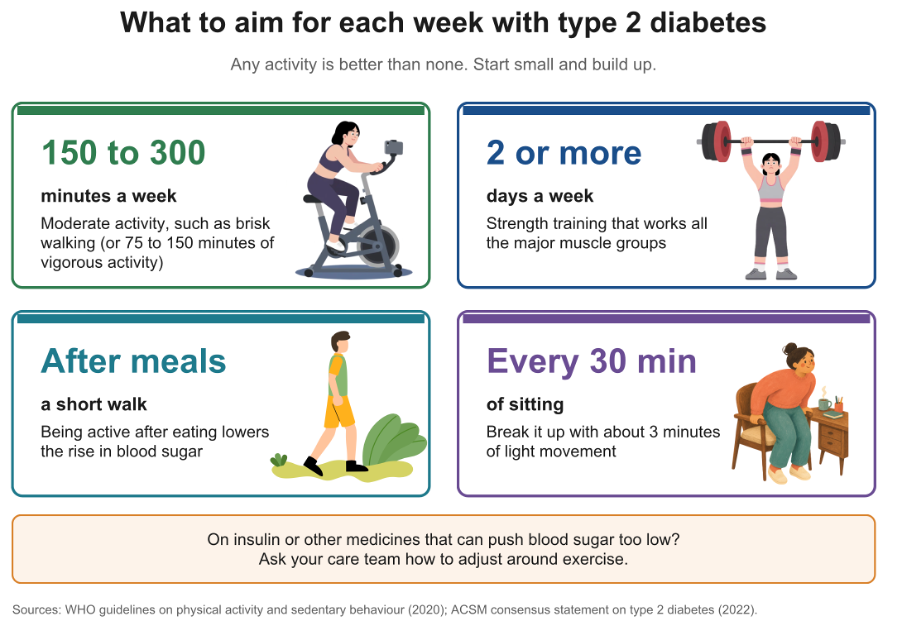
If you use insulin or other medicines that can cause low blood sugar, or live with diabetes-related complications, check with your care team before increasing activity.
In routine care, up to half of people stop these medicines within a year, and much of the benefit fades after that. Exercise may help people hold on to their gains. In the Danish S-LiTE trial, adults with obesity but without diabetes who had done supervised exercise regained 6 kg less in the year after treatment than those who took the GLP-1 medicine liraglutide alone. They were also still more active.
Plenty is still unknown, including the best way to combine activity with these medicines and what it does for diabetes during and after treatment. A 2026 review found only one trial that followed exercisers after the medicine stopped, and its main outcome was weight rather than diabetes. Physical activity researchers are well placed to run the missing trials.
Напутственные слова
- Physical activity belongs at the centre of diabetes care, with or without GLP-1 medicines.
- If you take a GLP-1 medicine, strength training may help protect your muscle, and staying active may help you keep your gains once treatment stops.
- We need trials of activity alongside these medicines, with diabetes as the outcome. Physical activity researchers can run them
Автор: Bushra Ali FRSPH FCIMSPA (Chartered) | London Sport Institute, Middlesex University London