English
  العربية
  简体中文
简体中文  Français
  Deutsch (Sie)
  Русский
  Español
Why treating 65 to 100+ as one group weakens practice, and two ideas that sharpen it.
The evidence base for physical activity in later life is strong particularly for single and multiple morbidities that become more common with age (see Atkin and colleagues). However, there are two other aspects of exercise prescription worth the practitioner’s consideration.
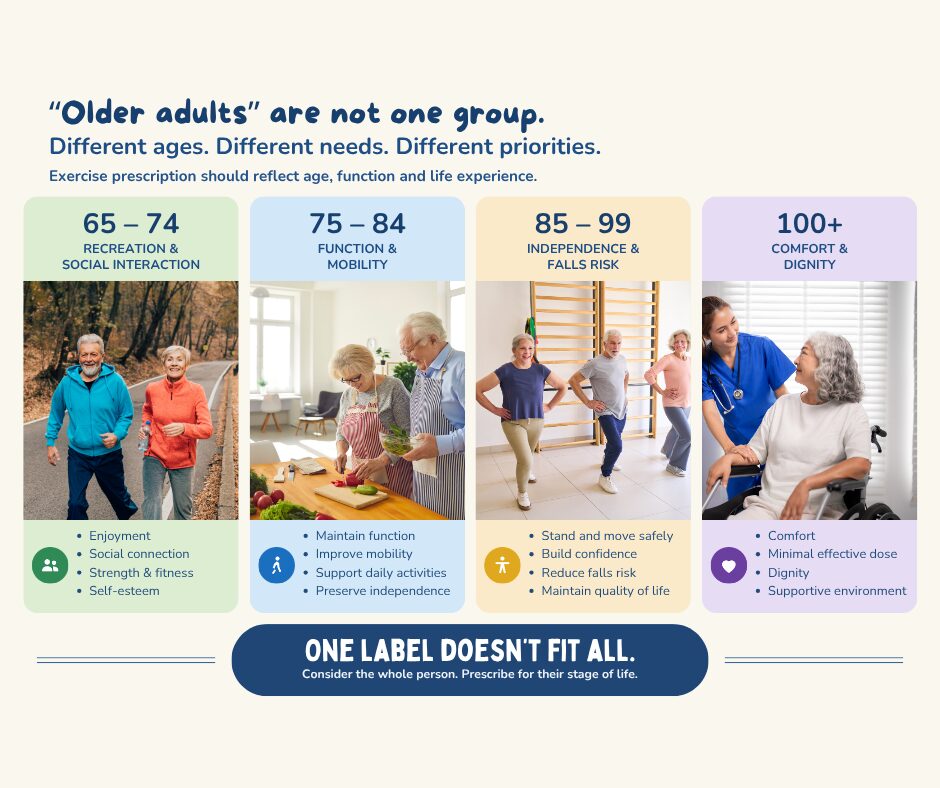
The first is age. We differentiate exercise carefully across childhood. Nobody would hand a four-year-old’s programme to a fourteen-year-old, because competencies change and the evidence says so. In later life we do the opposite. One common descriptor, “older adults”, covers everyone from 65 to over 100 years. That is a 35-year span, and yet a universal prescription remains common practice, even though exercise suited to a 68-year-old may be impossible for an 88-year-old.
Spirduso, Francis and MacRae proposed five sub-groups instead, each with different priorities:
| Sub-Group | Age | Typical Priorities |
|---|---|---|
| Middle age | 45 – 64 | Prevention, capacity, work and family demands |
| Young old | 65 – 74 | Recreation, social interaction, strength and self-esteem |
| Old | 75 – 84 | Function, mobility, activities of daily living |
| Old old | 85 – 99 | Independence, confidence, falls risk |
| Oldest old | 100+ | Comfort, minimal effective dose, dignity |
The second is how the evidence gets built. Most physical activity research is quantitative and works by narrowing its sample, so the field has produced detailed knowledge inside separate age silos that rarely speak to one another. Frost and McClean called this an ‘oversimplification of human experience’. Every practitioner already knows why: a client’s attitude to exercise was formed long before they walked through your door.
Life course research offers a way in. Glen Elder set out five principles linking a person’s past to their present: lifespan development, human agency, time and place, timing, and linked lives where development continues throughout life. People make choices within the constraints of their history and circumstances. They live interdependently and their choices are dictated by the environments and people around them. Alwin brought original theories around lifecourse together whilst Dannefer added that lives are socially constructed and reshaped by the organisations people pass through. Hendricks added that era and geography set the moral and social norms a person makes choices within.
By asking a client about their lifelong relationship with exercise or inactivity, you can discover reasons for their present beliefs and use that understanding to develop adherence; an 88-year-old who tells you she stopped exercising at school, whose spouse has died, and who has never seen anyone her age in a gym is not unmotivated, she is giving you clues to use to change her future health outcomes.
This pattern is not only in the literature but was observed in my own practice; clients who avoided exercise often traced it to poor school PE experiences, a link my colleagues and I examined in Elliott and colleagues (2022).
This theory works on you too. Your own life course shaped how you came to this work, and what your assumptions are about what clients’ want from a session. Such assumptions are worth examining before you examine your client’s.
Напутственные слова
- Ask which age sub-group your client sits in before you prescribe anything. A 68-year-old and an 88-year-old need different plans.
- Ask what physical activity has meant to them until now. Attitudes formed decades ago predict adherence today.
- Then ask the same of yourself. Your own history shapes what you assume a client of that age wants.
Автор
Dr Anne Elliott & Mrs Bushra Ali | London Sports Institute, Middlesex University