English
  العربية
  简体中文
简体中文  Français
  Deutsch (Sie)
  Русский
  Español
How do we move from knowing that schools matter for children’s physical activity, to creating lasting change that reaches every child?
This question shaped one of the legacy activities from the International Whole-School Physical Activity Conference (#WSPA2024) held at the University of Bradford, UK. Rather than viewing the conference as an endpoint, we wanted to use it as an opportunity to capture the collective expertise of those working across research, policy and practice and ask a simple question: what should happen next if whole-school physical activity (WSPA) is to become embedded within education systems?
The result is our recently published paper in the المجلة الدولية للتغذية السلوكية والنشاط البدني, which presents 24 co-designed recommendations developed by more than 150 delegates representing 16 countries.
Schools don’t need another initiative
Across the world, schools continue to be recognised as one of the best investments for increasing children’s physical activity. Yet despite decades of research and numerous successful programmes, implementation at scale remains inconsistent.
Schools exist within complex educational, political and community contexts. Decisions about curriculum, accountability, teacher workload, funding, leadership and local priorities all influence what is possible. This means that successful implementation cannot be separated from the context in which it takes place. Yet too often, physical activity is delivered through short-term projects that rely on enthusiastic individuals, external funding or isolated programmes. When these disappear, progress can disappear with them.
Our findings suggest that the challenge is not simply about identifying effective interventions, it is about creating the conditions that allow physical activity to become part of everyday school culture. That means thinking beyond programmes and towards systems.
Learning from people who make change happen
One of the most rewarding aspects of this work was bringing together people who view whole-school physical activity from very different perspectives. Researchers, teachers, school leaders, policymakers, charities, public health professionals and national organisations from 16 countries worked together to identify what they believed was needed next. Delegates collectively explored the roles of policy, practice and research before co-designing and prioritising recommendations for each sector.
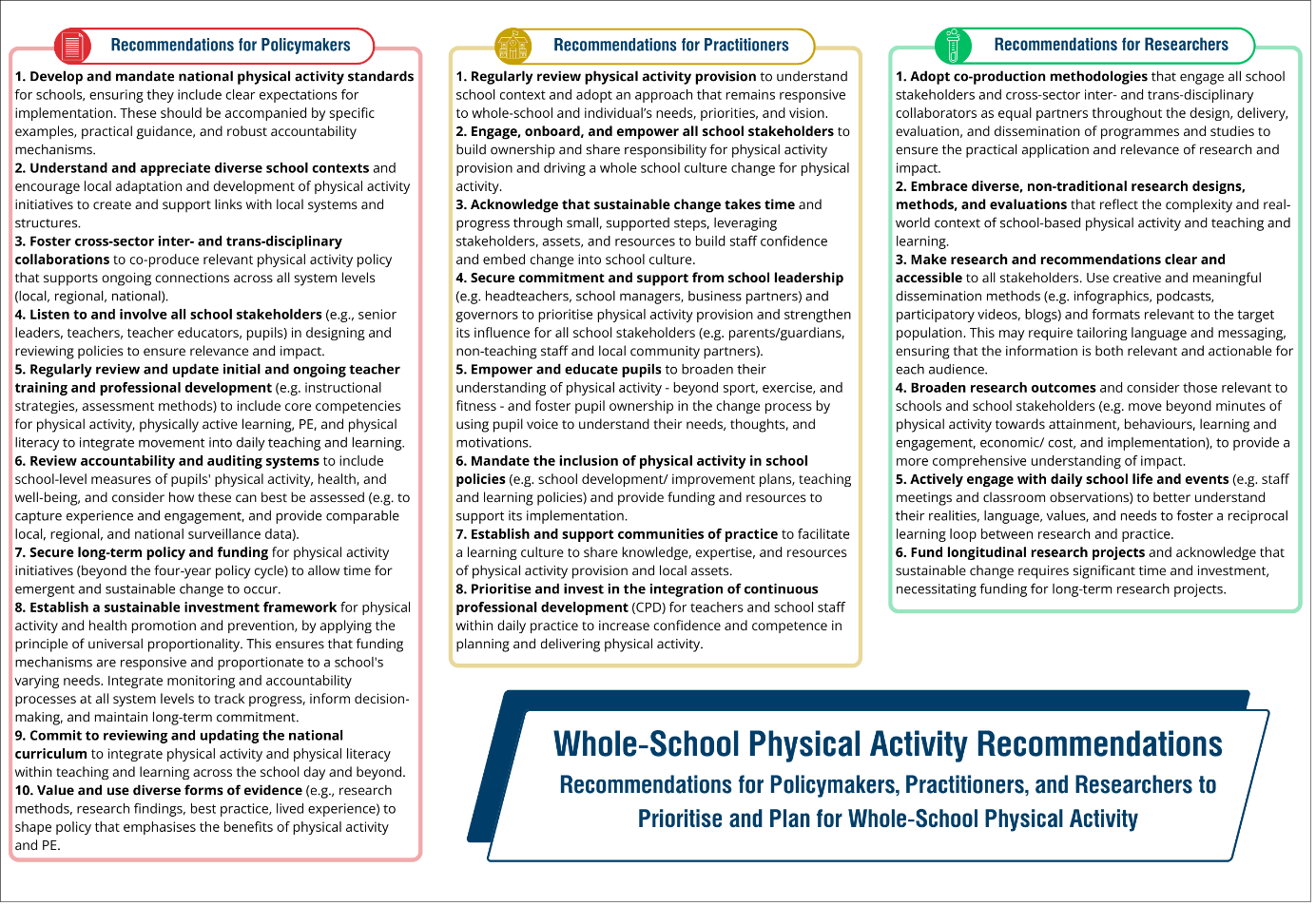
The result was 24 recommendations that reflect the collective experience of those developing, implementing, evaluating and supporting whole-school physical activity across diverse international contexts, see Figure 1.
Six conditions for sustainable change
Although the recommendations differed for policymakers, practitioners and researchers, six common themes were identified that underpin sustainable implementation.
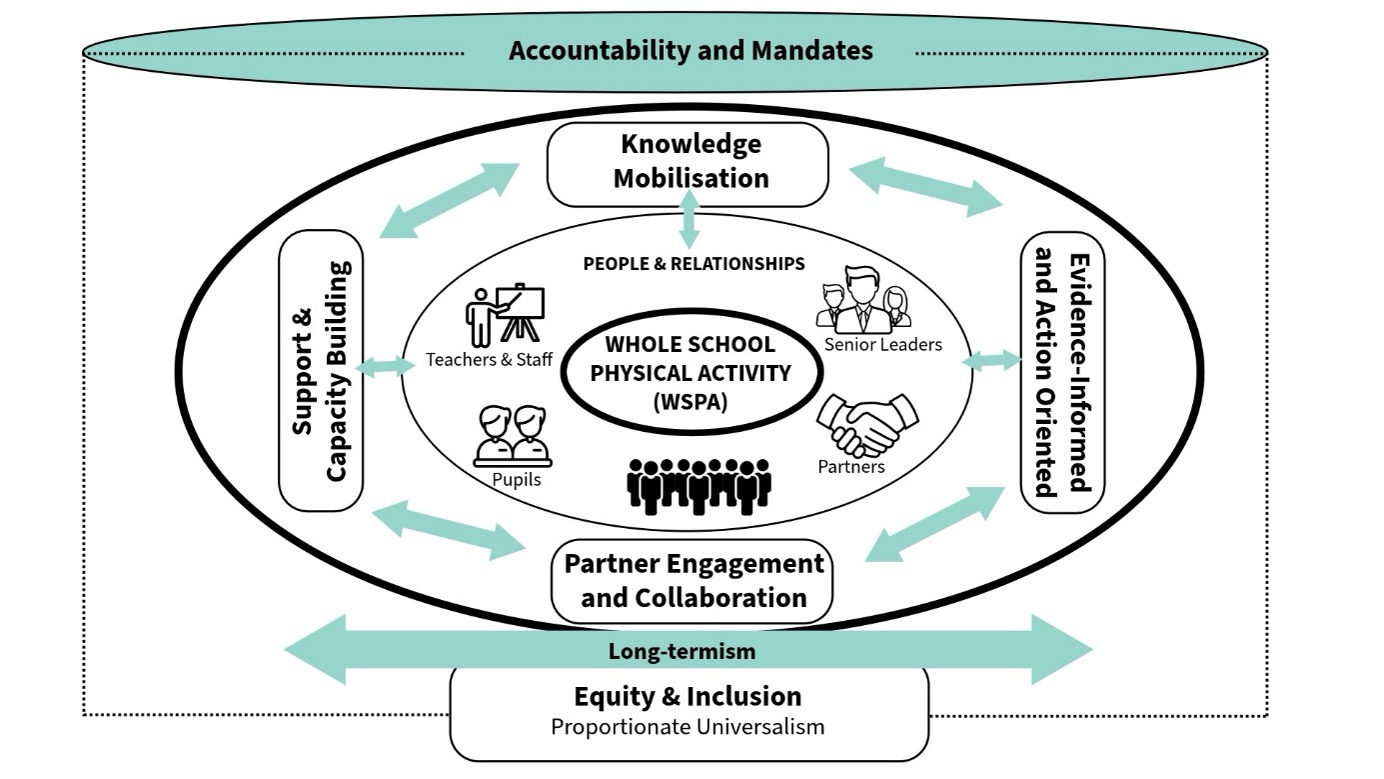
- First, whole-school physical activity must be understood as a systems issue, recognising that schools operate within wider education, health and community systems.
- Second, meaningful partnerships and collaboration are essential. Sustainable change cannot be delivered by one organisation or one sector acting alone.
- Third, equity and inclusion must sit at the centre of decision making. Every child should have opportunities to move, regardless of their background or circumstances.
- Fourth, we need to be evidence-informed and action-oriented, valuing not only research evidence but also practitioner expertise and lived experience.
- Fifth, knowledge mobilisation matters. Evidence only creates impact when it is shared in accessible ways and translated into practical action.
- Finally, long-term support and capacity building are needed so that schools have the confidence, resources and professional learning required to sustain change over time.
Together, these themes form an empirically informed systems model that positions whole-school physical activity not as a single intervention but as an ongoing process of cultural change, see Figure 2 below.
Looking beyond physical activity
For many years our field has understandably concentrated on demonstrating effectiveness. However, one of the strongest messages from delegates was that success should not be measured solely through minutes of moderate-to-vigorous physical activity. Schools are complex environments where movement supports learning, wellbeing, social connection, inclusion and belonging. If we want physical activity to become embedded within education systems, we also need research, policy and accountability frameworks that recognise these broader outcomes.
A shared responsibility
Perhaps the most encouraging finding from this work was the remarkable consensus across sectors. Despite different professional roles and national contexts, delegates consistently called for stronger collaboration, co-production and shared ownership. No single group can achieve this alone, for example,
- Researchers need to spend more time understanding school realities.
- Policymakers need to work alongside practitioners when designing policy.
- Schools need support, flexibility and professional learning rather than additional short-term initiatives.
From conference conversations to collective action
#WSPA2024 was designed to be more than a conference. It was an opportunity to bring together international expertise, challenge assumptions and create something that would outlast the event itself. These recommendations represent one part of that legacy. They offer a starting point for dialogue across sectors about how policy, practice and research can become better connected. They recognise that each stakeholder group has distinct responsibilities, but also that meaningful progress depends on working collectively rather than independently. The challenge now is not generating more ideas but acting on them.
If we truly want every child to benefit from whole-school physical activity, we must move beyond isolated programmes and work together to create the systems that make active schools the norm, not the exception.
We hope these recommendations stimulate discussion, inspire collaboration and encourage organisations across the physical activity, education and health sectors to consider the role they can play in creating lasting systems change for children and young people. If these recommendations encourage new partnerships, prompt reflection or help strengthen whole-school physical activity within schools, organisations or governments, then the conversations that began at #WSPA2024 will have achieved exactly what we hoped they would.
رسائل إلى المنزل
- Whole-school physical activity is a systems change agenda, not a programme. Creating active schools requires long-term change across policy, practice and research. Sustainable progress depends on embedding physical activity within school culture, leadership, curriculum and decision-making, rather than relying on short-term initiatives or individual champions.
- Collaboration is essential for lasting impact. Researchers, policymakers, practitioners and schools each have a critical role, but meaningful change only happens when these groups work together. Co-design, knowledge exchange and shared ownership are key to translating evidence into practice and developing solutions that are relevant to real-world school contexts.
- Equity and implementation must be at the heart of future action. The challenge is no longer simply identifying what works, but understanding what works, for whom, in what context and why. Future policy, research and practice should prioritise equity, value lived experience alongside research evidence, and invest in the long-term capacity needed to ensure all children can benefit from whole-school physical activity.
من تأليف:
- Dr Anna Chalkley, Institute of Health and Social Care, University of Bradford
- Dr Zoe Helme, Institute of Health and Social Care, University of Bradford
- Dr Ellen Silva, Bradford Institute for Health Research, Bradford Teaching Hospitals Foundation Trust
- Shania Boom, Institute of Health and Social Care, University of Bradford
- Professor Andy Daly-Smith, Institute of Health and Social Care, University of Bradford